
Breast Surgery · In three chapters
Breast Reduction Surgery
Who it suits, which technique is chosen and how recovery really goes, in three chapters.
01
What is breast reduction surgery?
Understanding

Breast reduction surgery (reduction mammaplasty) removes excess breast tissue, fat and skin to make large breasts smaller, lifted and in proportion with the body. The nipple is also moved to a new, higher position.
The aim is to relieve the problems that large breasts cause. The most common complaints are neck, back and lower back pain, and difficulty finding or wearing the clothes you want.
Large breasts also strain the skin: redness, chafing and fungal infection under the breast, poorer skin quality and stretch marks are common. Breast reduction is therefore about everyday comfort, not only appearance.
Most of our patients expect the operation to be very hard and painful. In fact, patients are up and walking 4–6 hours after surgery, go home the next day and can manage daily tasks that do not involve heavy lifting.
02
Is it right for you, and which technique is chosen?
Deciding
It can be performed for any woman over 18 who is troubled by large breasts. At the consultation we assess breast size and the degree of sagging, and ask about any family history of breast cancer, other medical conditions and medicines. We also look at how close you are to your ideal weight, because weight changes affect the result.
There are many breast reduction techniques; the choice depends on your expectations and the examination. Most often we use a technique in which the nipple keeps its blood supply from the upper inner tissue (superomedial pedicle). Less often we use one in which the nipple is supplied from the lower tissue (inferior pedicle), and in selected patients one in which the nipple is removed and grafted to its new position (free nipple graft).
“A patient's own tissue is always more valuable.”
Who it suits
Women over 18 troubled by large breasts: neck, back or lower back pain, difficulty with clothing, skin problems under the breast.
Who it is not for
Under-18s, anyone in active breast cancer treatment, anyone with a suspicious lump that has not yet been diagnosed, and patients with serious systemic illness and a high anaesthetic risk.
If you plan a pregnancy
If you plan to have a child soon, we recommend waiting until after the birth. We schedule the operation at least 6 months after breastfeeding has ended.
Will I be able to breastfeed?
It may be affected. The exact location of the milk glands is hard to determine; if the tissue removed contains many glands, you may breastfeed less or not at all. In studies, about 62% of women were able to breastfeed after breast reduction.
Is the result permanent?
The breast is a dynamic organ: later weight changes, pregnancies and lifestyle will always affect the result.
| Upper inner (superomedial) | Lower (inferior) | Free nipple graft | |
|---|---|---|---|
| Use | Most often | Less often | Selected patients |
| Nipple | Stays attached to upper inner tissue | Stays attached to lower tissue | Removed and grafted to its new position |
| Suitable for | Most patients | Most patients | Very large breasts or a high risk to blood supply |
Which technique suits you is decided at the consultation, based on breast size and the degree of sagging.
Would you like to get started?
Op. Dr. Ömercan Yağız Öksüz · FEBOPRAS · Bağdat Avenue, Istanbul
03
Surgery and recovery
The process
- 1Consultation and planning
Breast size and sagging, family history, other conditions and medicines are assessed, and the technique is chosen.
- 2The operation
Under anaesthesia, excess breast tissue and skin are removed, the breast is reshaped and the nipple is moved to its new position. A drain is placed for every patient.
- 3Walking the same day
Patients are always up and walking 4–6 hours after surgery and go home the next day.
Recovery stages
5 stages; strenuous exercise after the first month.
- In hospitalDay of surgery and the next day
- DrainsDays 1–3
- First weekWeek 1
- Back to daily lifeDay 10 – month 1
- Full returnAfter the first month
- In hospitalDay of surgery and the next day
- Up and walking after 4–6 hours
- Home the next day
- No heavy lifting
- DrainsDays 1–3
- Drains are removed on day 1, 2 or 3, depending on the amount of fluid
- Check-up on day 3
- Keep the support garment on
- First weekWeek 1
- Showering is allowed if all is well
- Week 1 check-up
- Light tasks without heavy lifting
- No heavy lifting
- Back to daily lifeDay 10 – month 1
- Light work from day 10
- Check-ups at week 2 and month 1
- Support garment for 4–6 weeks
- No strenuous exercise
- Full returnAfter the first month
- Strenuous exercise can begin
- Check-ups at months 3 and 6
- Scars fade over time
- Weight changes and pregnancy affect the result
Shower
Week 1
Light work
From day 10
Strenuous exercise
After month 1
Support garment
4–6 weeks
Drains
Days 1–3
Check-ups
Day 3, weeks 1 and 2, months 1, 3 and 6
Timings vary from person to person; each step is agreed with your surgeon at check-ups.
Possible risks
- Reduced blood supply to the nippleThe most important risk, but uncommon (1–2% in our surgeon's patients, also rare in the literature). Follow-up is increased; hyperbaric oxygen or topical treatment may be used and stitches may be opened temporarily.
- Change in nipple sensationTemporary in most patients; permanent in some.
- Effect on breastfeedingIf the tissue removed contains milk glands, breastfeeding may be reduced or not possible.
- Delayed wound healingMore common with poor wound care or other medical conditions; careful patient selection reduces it.
- ScarsAlways present and fade over time; healing varies from person to person.
- InfectionUncommon as long as the aftercare plan is followed.
04 · Cases
Breast reduction before and after
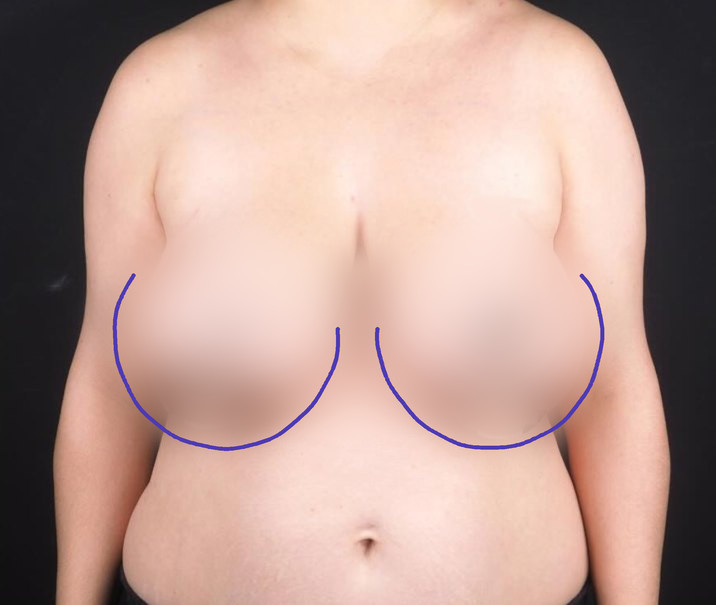 BEFORE
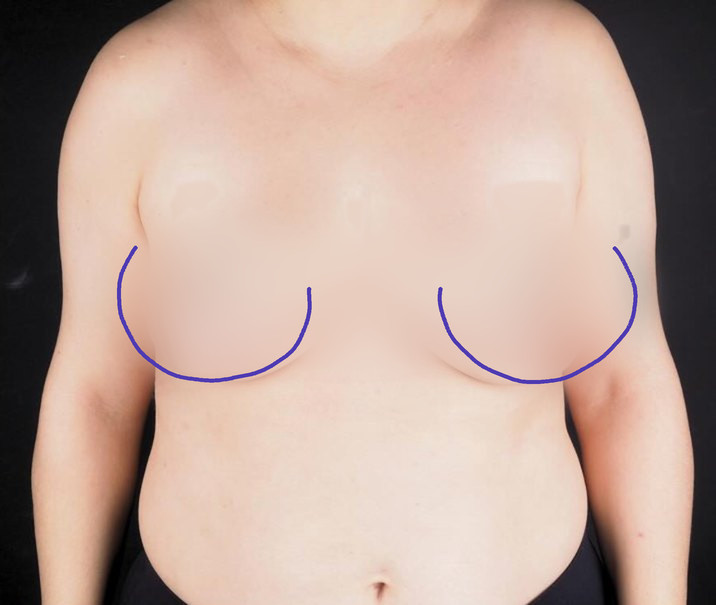 AFTER
The images are of Op. Dr. Ömercan Yağız Öksüz’s own patients; they were taken in the same setting under the same technical conditions and are shared with the patient’s written consent. The breast area is blurred for privacy and the breast contour is shown with a drawn line; no other changes have been made. Results of any surgical or interventional procedure may vary from person to person. The images are not a promise of results.
Frequently asked
Questions you may still have
Will my breasts grow again after surgery?
They may grow if you gain weight, but they will never return to their original size.
Will my breasts sag again?
They may. But because the breasts are lighter, in most patients sagging does not return to its original degree.
Does it lower my breast cancer risk?
It is hard to say the risk disappears; as long as breast tissue remains, screening should continue. The removed tissue is sent for pathology, so a risky lump can be detected.
Can you remove my breasts completely and use implants?
In theory yes, but we only do this when there is a medical reason. Without a risk factor, your own tissue is always more valuable.
Will I lose nipple sensation?
It can happen. In most patients it is temporary; in some it may be permanent.
What happens if there is a blood supply problem in the nipple?
Follow-up is increased; hyperbaric oxygen or topical treatment may be used. Sometimes the nipple stitches are opened temporarily and closed again once the circulation recovers.
Is there a risk of infection?
The risk is low as long as the aftercare plan is followed.
Is there an alternative to surgery?
No. There is no lasting way to reduce large breasts without surgery.
Leave your number and we will call you
We can answer your questions at an initial consultation.
Thank you
Your request has reached us. We get back to you within 24 hours, except on Sundays, Mondays and public holidays.
 Op. Dr. Ömercan Yağız Öksüzauthor and medically responsible physician
Published and last updated: 29 November 2026
6 min read
Sources
- American Society of Plastic Surgeons · Breast reduction recovery
- Kraut RY et al. The impact of breast reduction surgery on breastfeeding. PLoS One, 2017
- Breastfeeding outcomes after reduction mammaplasty: a systematic review and meta-analysis. Aesthetic Plast Surg, 2023
- Tanas Y, Tanas J. Superomedial and inferior pedicles in breast reduction and mastopexy: a meta-analysis. Aesthetic Plast Surg, 2024
Related pages